You're Not Competing with AI - You're Competing with Engineers Who Use It
I’m not saying this after a weekend of trying AI tools. I’m saying this after 2 years of using Cursor consistently - while working a demanding full-time job. And I’ll be direct: The way most engineers are still writing code today is already outdated.
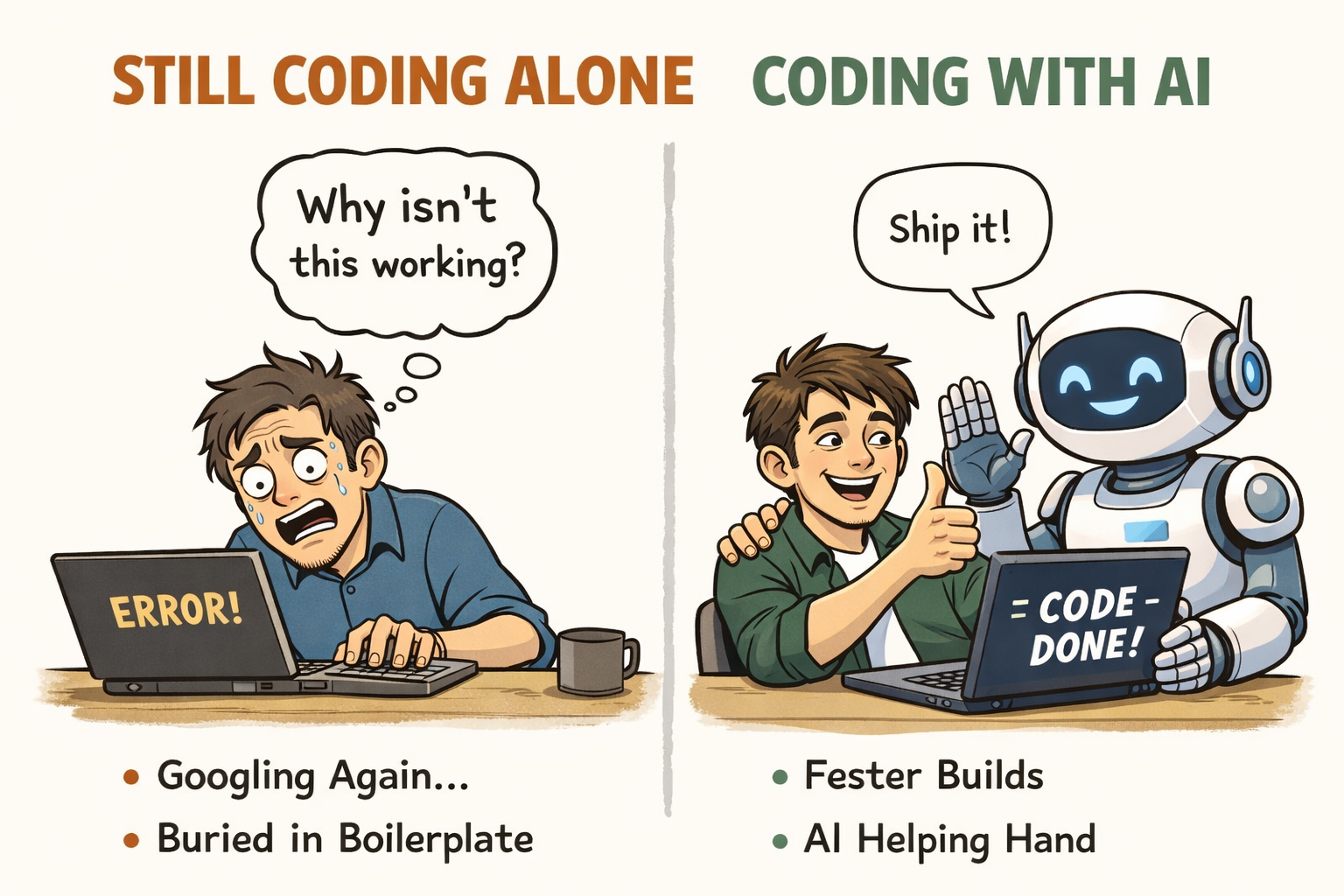
Let’s Say the Quiet Part Out Loud
If you’re still:
- Manually writing boilerplate
- Googling patterns you’ve implemented 100 times
- Stitching together repetitive logic
You’re not demonstrating skill. You’re demonstrating resistance to leverage.
My Turning Point
When I first started using Cursor, I used it like autocomplete. That was a mistake. The real shift happened when I treated it like a collaborator.
I was building a data pipeline:
- Ingestion
- Schema validation
- Transformations
- Feature logic
Normally: a couple of days.
This time, I described the system in plain English:
- Inputs
- Outputs
- Constraints
- Edge cases
Cursor generated a working structure in minutes. Not perfect. But good enough to skip hours of setup. What used to take days took a few hours.
After repeating this over months: I realized this isn’t a trick. This is the new baseline.
What 2 Years of This Looks Like (With a Full-Time Job)
Here’s the part that really changed my perspective: All of this was built outside my day job. Not by grinding nights endlessly. But by reducing the cost of building.
Over the past couple of years, I’ve built:
- An AI blog writing agent (research → structure → draft) - Check it out
- An event management app: https://tribe-connect-two.vercel.app/
- Pybenders - LLM-powered reels generator, multiple visual formats, 12+ content contexts, multi-platform output - pybenders/README.md at main · eerla/pybenders
- A full data engineering guide: https://eerla.github.io/data-engineering-blog/
- An Interview Assist tool: resume scanning, auto-generated interview questions, structured evaluation - https://intervue-assist.streamlit.app/
- Thrive: mobile app where users receive daily customized motivational quotes powered by LLM - eerla/Thrive: initial commit
And several smaller tools and browser extensions that I use locally.
The Part Most Engineers Won’t Like
None of this required:
- Months of effort per project
- Perfect architecture upfront
- Doing everything manually
Because I wasn’t. AI handled:
- Boilerplate
- Scaffolding
- Repetitive logic
- First drafts
I focused on:
- What to build
- How it should work
- What actually matters
The Lie Engineers Tell Themselves
“I want to understand everything deeply.”
After 2 years of working like this: Depth doesn’t come from writing everything yourself. It comes from:
- Reviewing
- Questioning
- Refining
- Iterating faster
AI doesn’t remove depth. It removes wasted effort disguised as depth.
The Real Threat (Be Honest)
If AI can generate most of your code… Then most of your code was never your advantage.
Your advantage is:
- Judgment
- System design
- Problem framing
- Speed of iteration
If your identity is tied to typing code manually… This shift will feel uncomfortable.
A Simple Example
Messy module:
- Duplicated logic
- Unclear structure
Before: Hours of refactoring
Now: “Clean this up. Improve readability. Don’t change behavior.” Done in seconds.
My job?
- Validate
- Refine
- Move forward
This Is Not a Productivity Hack
This is where people underestimate it.
It’s not: “I save some time”
It’s: “I build at a completely different scale”
You:
- Try more ideas
- Ship more projects
- Abandon bad paths faster
- Take bigger risks
That’s not speed. That’s leverage.
The Gap Is Already Forming
After 2 years, I can say this confidently: There are now two types of engineers:
- Writes code
- Builds with AI
Same intelligence. Completely different output.
“I Don’t Want to Be Dependent”
You already are. On:
- Frameworks
- Libraries
- Open-source
AI is just the next layer. Refusing it isn’t discipline. It’s denial.
The Uncomfortable Ending
In a year, saying: “I don’t use AI to code” will sound like: “I don’t use the internet when I code.”
Final Line
You’re not competing with AI. You’re competing with engineers who have been using it for 2 years - while working full-time - and shipping consistently. And they’re not slowing down.
This isn’t about Cursor. You can replace it with any AI tool. The real point is, engineers who learn to leverage AI will outpace those who don’t - regardless of which tool they use.
If you’re building data platforms, exploring lakehouse architectures, or just curious about how modern data systems achieve reliability, connect with me on LinkedIn.